
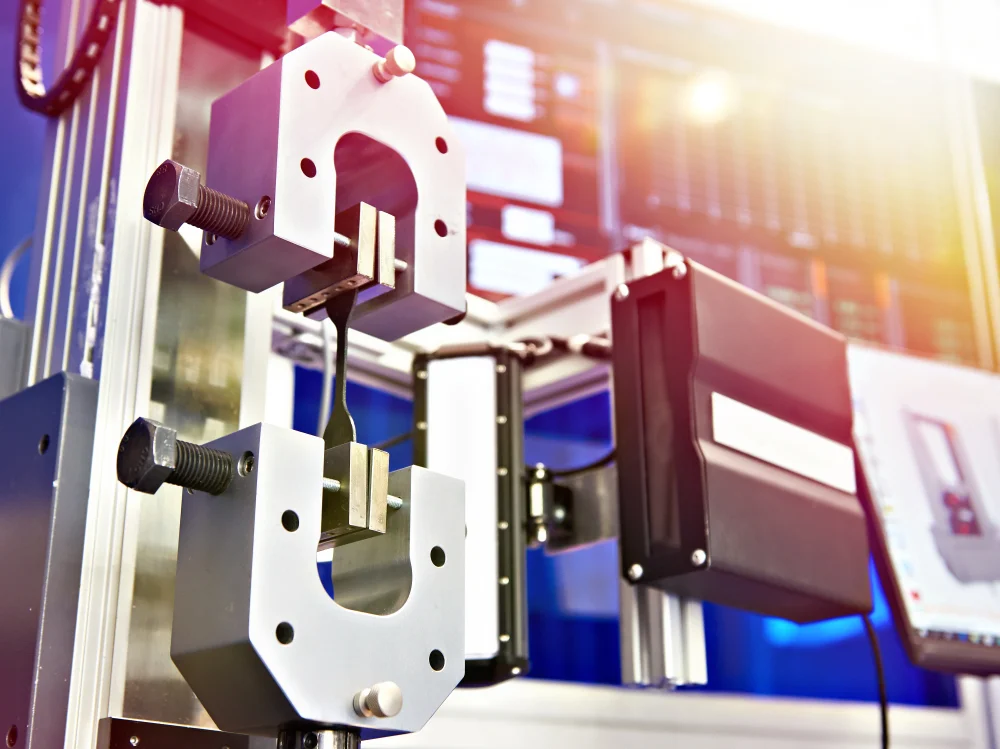
IEMA provides a comprehensive range of mechanical testing services for both metallic and nonmetallic materials, as well as components and specialty products. Our team of experts delivers precise, dependable, and prompt results that are customized to meet the specific standards or testing needs of your project.
Why mechanical Testing matters
Mechanical testing, also known as destructive testing, is crucial for research and development to ensure that materials meet safety standards for their intended purposes. Engineers depend on this testing to assess important properties such as strength, toughness, ductility, and stiffness. IEMA provides a wide variety of tests, including abrasion resistance and specialized tests like Charpy impact, creep, and fatigue testing. Our specialists apply controlled forces that simulate real-world conditions such as tension, compression, bending, and shear to ensure that materials are safe, dependable, and perform at their best. Choose IEMA for accurate evaluations that improve the quality and reliability of your materials.
Advantages of Choosing IEMA for Mechanical Testing Services
Rapid Results to Meet Your Deadlines: Time constraints can pose a significant challenge, but IEMA offers swift results to help you adhere to project timelines by providing a comprehensive range of mechanical testing services from a single supplier.
Expert Guidance for Compliance: IEMA’s specialists assist in meeting industry standards and regulatory requirements across various sectors, including Aerospace, Defense, Automotive, Construction, Energy, Medical Devices, and Transportation.
Improved Precision and Accuracy: Emphasizing precision and accuracy in mechanical testing, IEMA ensures the reliability, strength, and durability of components in industries such as Manufacturing, Automotive, Construction Metallurgy, Consumer Electronics, and Transportation.
Innovative Approaches to Material Integrity: IEMA’s advanced mechanical testing methods push materials to failure, offering innovative solutions for assessing material integrity and lifespan.
Understanding Non-Metallic Materials: IEMA evaluates non-metallic materials, including composites, polymers, ceramics, elastomers, vinyl, and textiles, to provide insights into their strength, flexibility, and fatigue.
Testing Material Resilience in Varied Conditions: IEMA conducts mechanical testing under specific environmental conditions, such as extreme temperatures or humidity, to assess material behavior and resistance to environmental factors.
Comprehensive Material Analysis: In addition to mechanical properties, IEMA’s material analysis encompasses chemical composition, microstructure, corrosion resistance, and more, providing a comprehensive understanding of materials.