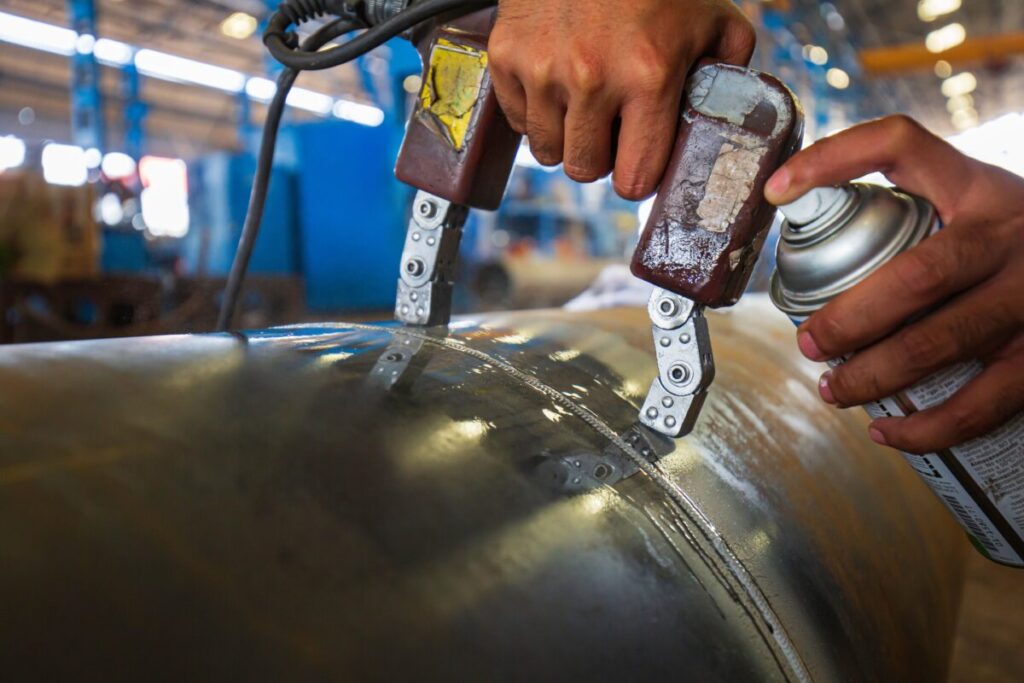
Magnetic particle inspection (MPI), also referred to as magnetic particle testing (MPT), is a non-destructive testing (NDT) technique utilized to detect surface and near-surface flaws in ferrous materials. Our magnetic particle testing is conducted either on-site or in our advanced laboratories.
This technique is most effective for examining ferrous materials such as nickel, iron, cobalt, and certain alloys, as it depends on a magnetic field to generate outcomes. Magnetic particle inspection is frequently used to test items like billets, bars, castings, forgings, fasteners, weldments, and extrusions.
Magnetic particle inspection methods
Magnetic particle inspection can be carried out using either a wet or dry technique, depending on the specific use case. In both methods, the product is given an electrical charge to generate a magnetic field. Subsequently, ferrous iron particles are administered to the component in a dry or wet suspension. If there is a crack or other imperfection, the particles will be drawn to the flaw and accumulate around the area to create an “indication.” This indication is then assessed to determine the nature and cause of the defect. The findings enable our Engaged Experts to comprehend the type and seriousness of any irregularities on the surface or within the part.
Ready to acquire the standard certification for your company?
We are highly appreciating the great job you have done for our company to issue our ISO 9001 certification; it was very efficient experience for us Very impressed with Racheal and Adeolu ( both auditors), we absolutely got first class professional service from you guys @IEMA, a breath of fresh air working with a company that wants to offer quality service from start to finish.

Our experience of working with IEMA has been fantastic and their certification process was really superb. In my career spanning over 20 years and in 11 countries across the world, I have worked with 7 various consulting companies and certification bodies but my best experience was with IEMA because of their skill of converting complicating ISO requirements into easy to implement modules that were absolutely easy to understand for my entire team
